


Page 33 - vectormsint_catalogue
P. 33
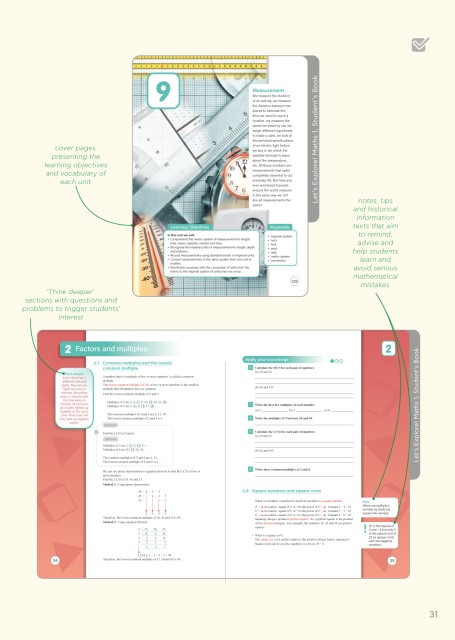
4 4 4 4 4 4 D e c im al s 4 4
Decimals
5 5 Write the equivalent recurring decimals.
1 1 Write the numerals. Secondary
Recurring decimals
(a) 54 hundredths Recurring decimals
There are fractions equivalent to decimal numbers that have a repeated pattern of
There are fractions equivalent to decimal numbers that have a repeated pattern of
(b) 367 hundredths numbers in their decimal part. These decimals are called recurring decimals.
numbers in their decimal part.
These decimals are called recurring decimals.
(c) 459 thousandths
(d) 13 tens 5 ones 6 tenths 2 hundredths Example
(e) 21 tens 7 ones 4 tenths 1 hundredth 3 thousandths (a) 1 = 1 ÷ 3 = 0.333... = 0.3 ˙
3
(f) 8 hundreds 6 ones 9 tenths 4 hundredths (b) 7 = 7 ÷ 12 = 0.5833... = 0.583 ˙ Let’s Explore! Maths 1, Workbook Let’s Explore! Maths 1, Workbook
12
2 2 Write the equivalent decimal fractions.
(a) 0.06 = (b) 0.23 = (c) 0.749 = (a) 1 =
6
(d) 0.003 = (e) 0.048 = (f) 0.815 = (b) 4 =
9
(c) 7 =
3 3 Write the equivalent decimals. 9
43
(a) 30 6 = (b) 28 7 = (c) 100 = (d) 5 =
11
4
(d) = (e) 62 = (f) 9 = (e) 5 =
27
5 1000 8
4 4 Write the equivalent decimals.
6 6 Put <, > or = in the boxes to compare.
Tip
Example Tip
t ch
e firs
ang
e mi
x
e
(a) 3 = 0.3 W We first change mixed d (a) 17.56 1.756 (b) 46.9 46.6 (c) 88.88 88.088
10 numbers to improper e r
op
numb
o impr
rs t
e
r
he
f
ac
ion
t
s and t
n t
(b) 6 99 = 6.99 fractions and then to o (d) 72.450 72.45 (e) 909.9 99.99 (f) 101.8 10.18
100 de decimal numbers. .
al numb
im
rs
e
c
(c) 3 125 = 3.125
1000
(a) 1 1 = ________________________________ (b) 1 7 = _________________________________ 7 7 Write the numbers in ascending order.
10 10
47
65
(c) 3 100 = _______________________________ (d) 9 100 = ________________________________ (a) 0.189, 0.1189, 0.1891, 0.1198, 0.198
85
41
(e) 10 1000 = _____________________________ (f) 12 1000 = ______________________________ (b) 0.345, 0.0345, 0.3054, 0.3405, 0.05
(g) 25 410 = _____________________________ (h) 31 287 = ______________________________
1000 1000
28 29
2 Factors and multiples
2
2.5 Co mmon factors
and the highest 2 F F F Factors and multiples s s s Using tech in maths…
iple
ac
ac
t
iple
iple
ac
ors and m
ors and m
ors and m
t
t
t
t
ul
ul
t
ul
common factor 2 Encourage Ss to learn more
• Draw S s’ attention to the 2.5 Common factors and the highest common factor 2.6 Multiples about factors by visiting the
theory section Common • What is a multiple? Note website http://www.math.
factors and the highest Note • What is a common factor? A multiple of a natural number is produced by multiplying the number by a Every number is a com/school/subject1/lessons/
A common factor of two or more numbers is a whole number that exactly
All numbers always
multiple of 1.
whole number. Multiples of a number are always greater than or equal to the
common factor. have number 1 as a divides all the numbers. number. S1U3L1GL.html
The highest common factor (HCF) of two or more numbers is the largest
common factor.
• Ask Ss What is a common whole number that exactly divides all the numbers. A multiple of the number 2 is a number that can be divided exactly by 2.
2, 4, 6, 8, 10, … are multiples of 2.
We can use the prime factorisation method to find the HCF of two or more
factor? numbers. 1 × 5 = 5
• Explain to Ss that a common The factors of 6 are 1 , 2 , 3 , 6 . 2 × 5 = 10 The first six multiples of 5 are 5, 10, 15, 20, 25, and 30. • Have Ss study the exa mples
3 × 5 = 15
of this section, and explain to
The factors of 18 are 1 , 2 , 3 , 6 , 9 and 18.
factor of two or more 4 × 5 = 20 Ss how we find the first four
numbers is a whole number Common factors of 6 and 18 are 1, 2, 3 and 6. 5 × 5 = 25 multiples of 4 and how we
6 × 5 = 30
The highest common factor of 6 and 18 is 6.
that exactly divides all the Example The numbers 5, 10, 15, 20, … are called the multiples of 5. check if 20 is a multiple of 3
numbers. 7 Find the HCF of 24, 36 and 48. Example and 5.
Solution 8 Write the first four multiples of 4.
Note Method 1: Using prime factorisation Solution Think deeper Let’s Explore! Maths 1, Teacher’s Book
Point out to Ss that all numbers 24 = 2 × 2 × 2 × 3 1 × 4 = 4 Think de e e e e e p p p p p e e e e e r r r r r • Ask Ss How many multiples
Think de
Think de
2 × 4 = 8
Think deeper
Think de
Think de
an
an
an
an
an
an
y m
y m
an
t
t
iple
iple
iple
w m
w m
iple
w m
an
w m
iple
w m
t
ul
ul
ul
iple
ul
ul
t
t
ul
ul
ul
t
y m
y m
y m
y m
t
y m
y m
t
iple
iple
w m
o
o
o
o
o
always have number 1 as 36 = 2 × 2 × 3 × 3 3 × 4 = 12 H H H H H H H H How many multiples s s s s s s s s of a number can you find?
o
o
w m
o
w m
48 = 2 × 2 × 2 × 3 × 2
umb
umb
umb
er can
er can
er can
er can
er can
umb
f a n
f a n
f a n
f a n
of a number can
umb
f a n
o o o o o
4 × 4 = 16
ind
ind
common factor. 2 × 2 × 3 = 12 The first four multiples of 4 are 4, 8, 12, 16. you f you f you find?? ? (We can find an infinite
Therefore, the highest common factor of 24, 36 and 48 is 12. 9 Check if 20 is a multiple of: number of multiples of any
• Explain to Ss that the highest Method 2: Using repeated division (a) 3 (b) 5 number, which means that
common factor (HCF) of 2 24, 36, 48 Solution the number of multiples of
two or more numbers is 2 12, 18, 24 (a) 20 ÷ 3 = 6 r2 A division with remainder any number is extremely
the largest whole number 3 6, 9, 12 Therefore, 20 is not a multiple of 3. large.).
2 3 6
that exactly divides all the HCF is 2 × 2 × 3 = 12 (b) 20 ÷ 5 = 4 A division with no remainder • Allow Ss some time to think
numbers and that we can use Therefore, the highest common factor of 24, 36 and 48 is 12. Therefore, 20 is a multiple of 5. about their answers.
prime factorisation method to • Encourage Ss to express their
find the HCF of two or more opinions, and initiate a short
numbers. discussion in class.
• Focus Ss’ attention on
the factors of 6 and 18, 32 33
and explain to Ss that the
common factors of 6 and
18 are 1, 2, 3 and 6 and the
highest common factor of 6 2.6 Mul itples
and 18 is 6. • Draw S s ’ attention to the theory section Multiples.
• Have Ss study the example • Ask Ss What is a multiple?
of this section, and explain • Explain to Ss that a multiple of a number is produced by
to Ss how we find the HCF multiplying the number by a whole number and that multiples of a
of 24, 36 and 48 using prime number are always greater than or equal to the number.
factorisation or repeated • Explain to Ss that a multiple of the number 2 is a number that can
division. be divided exactly by 2 (2, 4, 6, 8, 10, …).
Note
Point out to Ss that every number is a multiple of 1.
• Have Ss study the first six multiples of 5.
43
42
31 31
4/2/2026 10:39:10 πµ
Vector-Catalogue-2026_Maths.indd 31
Vector-Catalogue-2026_Maths.indd 31 4/2/2026 10:39:10 πµ

