


Page 54 - vectormsint_catalogue
P. 54
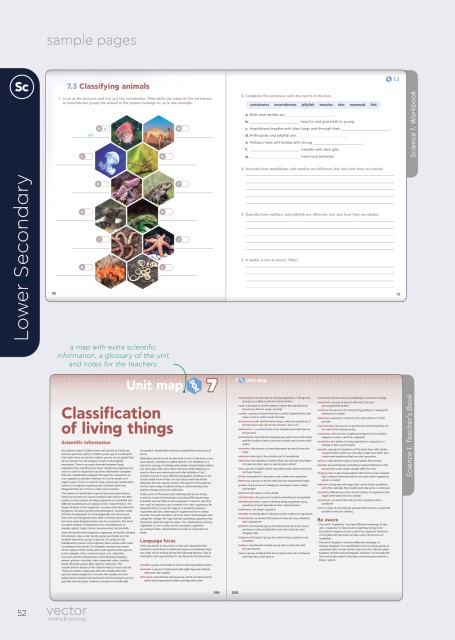
International Lower Secondary
Sample pages S SCIENCE
C
IE
NCE
7.
3
7.3 Clas sifying animals 7.3
Clas
sifying animals
Classifying animals
Vertebrates Invertebrates
on
t
a
t
ele
e all animals which ha
y ar
o the animal kingdom, and the
e an inner sk
es belong t
v
t
ebr
V Vertebrates belong to the animal kingdom, and they are all animals which have an inner skeleton Invertebrates are a group of animals of the
er
f the
In
e a gr
es ar
t
f animals o
ebr
t
er
a
oup o
v
with a backbone. There are different groups of vertebrates classified by their characteristics. animal kingdom. There are several groups of
invertebrates with a variety of characteristics.
Mammals: They are animals with fur or hair However, all invertebrates do not have an inner F
A on their bodies. They give birth to young, skeleton or a backbone.
which feed from the milk their mother Molluscs: They are animals with soft bodies,
produces. Mammals have lungs to breath e. but with strong muscles. Many of them have G Science 1, Student’s Book Science 1, Student’s Book
Reptiles: They are animals with scales, a shell which protects them. Sometimes this
Β and their skin is dry. They live on land and shell might be inside their body.
breath e with lungs. Sometimes we can also Jellyfish: They are animals that live in water.
see them in the water, but they lay their Their body is soft and jelly-like and they have
eggs only on dry land. The shell of their long tentacles which have stinging cells. They
eggs feels like leather. use these tentacles to get their food in the
Fish: They have scales and fins and they water.
live in the water. They lay soft and jelly-like Annelids: They are worms, like the earthworm.
eggs in the water and they breath e with Their bodies are soft and segmented. H
their gills.
C Flatworms: They have soft flat bodies which
Birds: They have feathers, wings and are not segmented. I
a beak. Most of them can fly and they
breath e with their lungs. Birds lay eggs Nematodes: They are worms that have soft J
with a hard shell. and thin bodies, which are not segmented.
Amphibians: They have a wet , smooth skin Echinoderms: They are animals that live in the
through which they can breathe. They also water, like the starfish. Their body is hard on
D the outside and covered with spines.
have lungs to breath e, and they spend time
both on land and in the water. However, Arthropods: They are animals with a
they lay their eggs only in water and they segmented body and legs with joints. They K
live in the water when they are young. Their also have a hard exoskeleton. There are many
jelly
-lik
e
ft and
eggs are soft and jelly-like. . animals in this group. Two smaller groups
eggs ar
e so
of arthropods are arachnids and insects.
? Arachnids, like spiders, do not have antennae ?
E
and they have eight legs in total. Insects, like In which group
In which group bees, have antennae, they have six legs and would you
would you classify they might also have wings. L classify an
a crocodile? octopus?
M
155
155
155
154154
154 155
154
7.
7.3 3
sifying
3
animals
7.
Clas
7.3 Clas sifying animals
Classifying animals
3. Draw lines to match.
nt
Dive into Science
ft and ha
e i
acles with s
t
en
o S
v
e long t
ells.
cience
e so
Di Di v v e i nt o S cience Flatworms ar are soft and have long tentacles with stinging cells.
tinging c
Jellyfish have segmented bodies with legs with joints and
What is a mus musculus? a har d e x osk ele t on.
a hard exoskeleton.
Mus musculus is the scientific name of what we Arthropods ha v e har d bodies on the outside c o v er ed with spines.
have hard bodies on the outside covered with spines.
know as the common mouse. Scientists have Annelids
orms with so
t
e w
ft, thin and non-segmen
ed bodies.
been trying to classify organisms into groups ar are worms with soft, thin and non-segmented bodies.
for many years. Today they use a classification Molluscs
orms with so
t
e w
ed bodies.
t non-segmen
ft and fla
system which was invented by Carl Linnaeus, ar are worms with soft and flat non-segmented bodies. Science 1, Student’s Book
a Swedish scientist, who lived in the 18th Echinoderms are worms with soft segmented bodies.
ed bodies.
ar
ft segmen
t
orms with so
e w
century. He gave each organism a
name with two Latin words, Nematodes have soft bodies with strong muscles.
like the mus musculus.
This naming system is
still used today.
or
e S
e S
or
Ex Ex
pl
pl
cience
cience
Activities Explore Science
Investigating animal classification
1. Answer the questions. 1 Choose one group of animals out of: Choose one group of animals out of:
mammals, reptiles, birds, fish, amphibians,
a. Which five groups of vertebrates do you know? molluscs and arthropods.
2 Do some research on this group of animals. Do some research on this group of animals.
3 Search for the characteristics of each Search for the characteristics of each
group and describe if it is a vertebrate or
b. Which seven groups of invertebrates do you know?
invertebrate group.
4 Find two animals that belong to this group Find two animals that belong to this group
and describe them.
2. Complete the table, as in the example. Make a presentation of your findings and discuss ? • What characteristics
did you search for?
them with your class.
Vertebrate groups Characteristics Reproduction Breathing
birds feathers, beak, wings lay eggs lungs Keywords Overview
give birth • Vertebrates are all animals which have an inner
mollusc flatworm skeleton with a backbone.
fish jellyfish nematode • Invertebrates are all animals without an inner
tentacle echinoderm skeleton nor a backbone.
stinging cell starfish • Vertebrates are grouped into mammals, reptiles,
scales, dry skin annelid arthropod fish, birds and amphibians.
worm arachnid • Invertebrates are grouped into molluscs, jellyfish,
wet smooth skin skin and lungs annelids, flatworms, nematodes, echinoderms,
and arthropods.
156 157
52
4/2/2026 10:45:46 πµ
Vector-Catalogue-2026_Science.indd 52 4/2/2026 10:45:46 πµ
Vector-Catalogue-2026_Science.indd 52

