


Page 29 - IPMaths_leaflet
P. 29
Sample page • Maths 3 • Teacher's Book
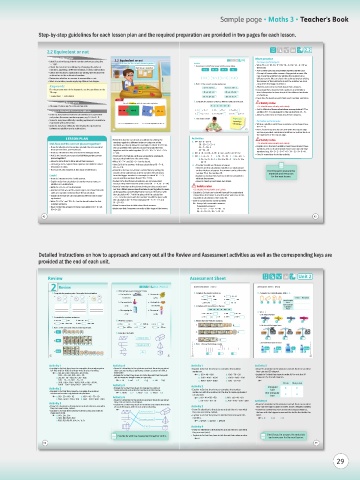
Step-by-step guidelines for each lesson plan and the required preparation are provided in two pages for each lesson.
2.2 Equivalent or not 2.2
Learning Objectives More practice
• Identify and write equivalent number sentences using the 2.2 Equivalent or not 2.2 For lower-performing Ss:
‘ = ’ sign. Did Alex put the correct pieces together? Activities • Write ‘15 + 4 = 19’, ‘9 + 17 = 18’, ’18 − 6 = 13’, ‘23 – 4 = 15’ on
• Check the result of an addition by changing the order of I think they are equivalent ! 1. Draw lines to match the boxes with the same value. the board.
numbers, applying a di erent strategy, or using subtraction. 16 + 5 38 – 30 24 – 7 22 • Ask Ss How can you check these number sentences?
• Check the result of a subtraction by adding the result of the (Accept all reasonable answers. Suggested answer: We
subtraction to the subtracted number. can check the additions by adding the numbers in a
• Determine whether an answer is reasonable or not. 13 + 4 12 + 9 2 + 2 + 4 32 – 10 di erent order. We can check the subtractions by adding
• Work on number puzzles applying di erent strategies. the answer of the subtraction and the number we took
2. Tick (4) the correct number sentences. away from the bigger number.).
Keywords 17 – 4 = 26 – 8 4 + 8 + 3 = 18 – 3 • Allow Ss some time to think about their answers.
For the presentation of the keywords, see the guidelines in the • Encourage Ss to express their opinions and initiate a
TB map. 15 + 4 = 23 – 4 25 + 4 = 17 + 12 short discussion in class about all the di erent methods
of checking.
> equivalent > calculation 16 – 4 = 27 – 12 30 – 15 = 7 + 7
• Have four Ss stand up and check each number sentence.
Look!
Materials and Resources We call calculations with the same value equivalent.alent. 3. Complete the number sentences with the numbers in the box. Safety rules
alue equiv
with the same v
• A4 paper (1 piece per S), coloured pencils 4 5 6 12 13 15 > Ss should move slowly and calmly.
• Ask Ss Which of these calculations are equivalent? (The
Common Student Preconceptions 16 – 7 = 20 – 6 a. 7 + = 15 – 2 b. 24 – = 19 – 7 c. 35 = 40 – addition 15 + 4 is equivalent to the subtraction 23 – 4.).
• Some Ss may believe that two calculations are equivalent d. – 5 = 7 + 2 + 1 e. 13 + 21 = 38 – f. 8 + 4 + = 22 + 3 • Allow Ss some time to think about their answers.
only when the same numbers appear, e.g. 5 + 6 = 6 + 5. 4 7 4. Let’s make a train! Keywords
• Some Ss may have di iculty creating equivalent calculations equivalent For higher-performing Ss:
expressed with subtraction. 12 + 11 is equivalent to 15 + 8. 16 – 7 is not equivalent to 20 – 6. calculation • Write an addition with three numbers on the board, (e.g.
• Some Ss may have di iculty identifying the equivalence 18 + 2 + 2).
between an addition and a subtraction. 22 22 23 23 23 • Have Ss stand up one by one and write the equals sign
and an equivalent calculation (addition or subtraction) on
the right side of the equals sign.
LESSON PLAN • Remind Ss that we can check an addition by adding the Activities Safety rules
Did Alex put the correct pieces together? numbers again in a di erent order or using one of the 1. 16 + 5 = 12 + 9 > Ss should move slowly and calmly.
38 – 30 = 2 + 2 + 4
methods we already know. For example, to check 12 + 11 = 23,
• Draw Ss’ attention to the picture and ask them to say what we can partition the numbers 12 and 11 and add the tens 24 – 7 = 13 + 4 • Explain to Ss that each addition must have at least three
they can see (Alex, puzzle pieces). together and the units together (12 + 11 = 10 + 2 + 10 + 1 = 20 + 22 = 32 – 10 numbers and each subtraction must have two two-digit
• Draw Ss’ attention to Alex and read the dialogue aloud. 3 = 23). 2. 4 + 8 + 3 = 18 – 3, 15 + 4 = 23 – 4, 25 + 4 = 17 + 12 numbers (e.g. 18 + 2 + 2 = 9 + 7 + 6 = 34 – 12 = 9 + 9 + 4).
• Ask Ss the introductory question Did Alex put the correct • Point out to Ss that we call these calculations equivalent, 3. a. 7 + 6 = 15 – 2 b. 24 – 12 = 19 – 7 c. 35 = 40 – 5 • Give Ss some time to do the activity.
pieces together? because they both have the same value. d. 15 – 5 = 7 + 2 + 1 e. 13 + 21 = 38 – 4 f. 8 + 4 + 13 =
• Allow Ss some time to think about their answers. • Write ‘16 – 7 = ’ and ‘20 – 6 = ’ on the board. 22 + 3
• Encourage Ss to express their opinions and initiate a short • Have Ss ind the answers to these calculations (16 – 7 = 9, 4. • Provide Ss with an A4 piece of paper.
discussion in class. 20 – 6 = 14). • Have Ss write a calculation (addition or subtraction)
• Don’t correct Ss’ answers at this stage of the lesson. • Remind Ss that we can check a subtraction by adding the on the A4 piece of paper. The answer can be either the Don’t forget to prepare the
answer of the subtraction and the number we took away number 15 or the number 18. materials and resources
Look! from the bigger number. For example, to check 16 – 7 = 9, • Explain to Ss that they have to write the calculation for the next lesson.
• Draw Ss’ attention to the Look! section. we can add the numbers 9 and 7 (9 + 7 = 16). without the answer.
• Explain to Ss that calculation is another way to name an • Explain to Ss that these calculations are not equivalent • Have Ss stand up and make two trains.
addition or a subtraction. because they don’t have the same value (16 – 7 = 9, 20 – 6 = 14). Safety rules
• Write ‘12 + 11 = 15 + 8’ on the board. • Draw Ss’ attention to the picture in the previous section and
• Remind Ss that we use the equals sign (=) to show that both ask them Which pieces does Alex have to put together to make > Ss should move slowly and calmly.
sides of a number sentence have the same value. all the puzzles correct? Why? (Alex has to put the piece with • Explain to Ss that one train will have all the equivalent
• Explain to Ss that we call calculations with the same value the calculation 16 – 7 with the piece with the calculation calculations that make 15 and the other will have all the
7 + 1 + 1 and the piece with the number 14 with the piece with
equivalent. the calculation 20 – 6. This is because 16 – 7 = 7 + 1 + 1 and equivalent calculations that make 18.
• Write ‘12 + 11 = ’ and ‘ 15 + 8 = ’ on the board below the irst 14 = 20 – 6.). • Give Ss some time to do the activity.
number sentence. Accept all reasonable answers.
• Have Ss ind the answers to these calculations (12 + 11 = 23, • Allow Ss some time to think about their answers. Suggested answers:
15 + 8 = 23). • Make sure that Ss answer correctly at this stage of the lesson. 10 + 5 = 22 – 7 = 19 – 4 = 40 – 25
24 – 6 = 10 + 8 = 19 – 1 = 12 + 6
42 43
Maths3_TB_U2.indd 42 1 /9/2020 11:32:30 πµ Maths3_TB_U2.indd 43 1 /9/2020 11:32: 0 πµ
Detailed instructions on how to approach and carry out all the Review and Assessment activities as well as the corresponding keys are
provided at the end of each unit.
Review Assessment Sheet Unit 2
2 Review Unit 2 Review Assessment Sheet | Unit 2 Assessment Sheet | Unit 2
1. Complete the number pairs. Then write the fact families. 4. What will you use to measure? Circle. d. The mass of a . 1. Complete the number sentences. 5. Complete the Carroll diagram. Write A-D.
a. The length of a
.
a. b. c. a. + 40 = 100 d. – 70 = 30
m / cm / km g / kg Prism Not prism
b. 600 + = 1000 e. 1000 – = 200 Has triangular
b. The capacity of a . e. The length of a . c. 500 + 500 = f. – 90 = 10 A B C D faces
Does not have
l / ml m / cm / km 2. Complete with the numbers in the box. triangular
200 60 10 50 400 30 faces
c. The capacity of a . d. The mass of .
6. Tick (4) .
l / ml g / kg a. 60 + 40 = 50 + b. 100 – = 10 + 30 a. the longest distance
2. Complete the number sentences. c. 50 + = + 70 d. 700 – = 500 –
100 m 1600 m 5 km 600 m
a. 50 + 20 = + 10 b. 100 – 40 = 70 – 5. Write the numbers. 3. What is the total? Write the numbers. A B C D
c. + 300 = 700 + 100 d. 600 – = 900 – 800 a. 1 km = m b. l = 7000 ml c. 6 m = cm a. $1 $1 $1 $1 $1 $1 $1 $1 $1 $1 25c 25c 25c 25c 25c 25c 25c 25c 25c $ b. the box with the biggest mass
3. Tick (4) the coins and notes to make each total. d. kg = 5000 g e. 1 l = ml f. m = 300 cm
1 kg kg 100 g 5 g 20 g
a. $1 50c 50c 25c 25c 25c 25c 25c 25c 5c 5c b. $1 $1 $1 $1 $1 $1 $1 $1 $1 $1 50c 50c $ 20 g 500 g 100 g 100 g 100 g 50 g
6. Draw lines to match.
pentagonal prism A B C
c. 5c 5c 5c 5c 5c 5c 5c 5c 5c
b. $80 $
© 500 ml 330 ml 2 l 1500 ml ©
triangular pyramid 4. Tick (4) the net that makes a cube. c. the bottle that holds the most
c. $46.57 A B C D
$1 $1 50c 50c 25c 25c 5c 5c 1c 1c 1c 1c cube A B C
38 39 222 223
Unit 2 Review
4. What will you use to measure? Circle.
Activity 1 Activity 4 . d. The mass of a . Activity 1 Activity 5
a. The length of a
• Explain to Ss that they have to complete the number pairs • Draw Ss’ attention to the pictures and ask them to say what • Explain to Ss that they have to complete the number • Draw Ss’ attention to the pictures and ask them to say what
g / kg
m / cm / km
for 100 and for 1000 and then write the fact families. they can see (a ship, a perfume, a bean, a carton of milk, a sentences. they can see (3D shapes).
a. 60, 40 + 60 = 100, 60 + 40 = 100, leaf, Kate). . e. The length of a .
b. The capacity of a
100 – 40 = 60, 100 – 60 = 40 • Explain to Ss that they have to circle the unit that they will a. 60 + 40 = 100 d. 100 – 70 = 30 • Explain to Ss that they have to write A D to sort the 3D
l / ml
b. 25, 25 + 75 = 100, 75 + 25 = 100, use to measure length, mass or capacity. m / cm / km b. 600 + 400 = 1000 e. 1000 800 = 200 shapes in the Carroll diagram.
100 – 25 = 75, 100 – 75 = 25 a. m b. ml c. l d. g e. cm f. kg c. 500 + 500 = 1000 f. 100 90 = 10
c. 300, 700 + 300 = 1000, 300 + 700 = 1000, c. The capacity of a . d. The mass of . Prism Not prism
1000 – 700 = 300, 1000 – 300 = 700 Activity 5 Activity 2
l / ml
Activity 2 • Explain to Ss that they have to change the units of g / kg • Explain to Ss that they have to complete the number Triangular B D
face
• Explain to Ss that they have to complete the number measurement and write the numbers in the boxes. sentences with the numbers in the box to make equivalent
a. 1000
b. 7
sentences to make equivalent calculations. 5. Write the numbers. c. 600 d. 5 e. 1000 f. 3 Not triangular C A
a. 50 + 20 = 60 + 10 b. 100 – 40 = 70 – 10 Activity 6 m b. l = 7000 ml c. 6 m = cm calculations. b. 100 – 60 = 10 + 30 face
a. 1 km =
a. 60 + 40 = 50 + 50
c. 500 + 300 = 700 + 100 d. 600 – 500 = 900 – 800 • Draw Ss’ attention to the pictures and ask them to say what c. 50 + 30 = 10 + 70 d. 700 – 400 = 500 – 200 Activity 6
kg = 5000 g
d.
e. 1 l =
f.
m = 300 cm
ml
Activity 3 they can see (nets, 3D shapes). • Draw Ss’ attention to the pictures and ask them to say what
• Draw Ss’ attention to the pictures and ask them to say what • Explain to Ss that they have to draw lines to match the name Activity 3 they can see (signs, balance scales, boxes, weights, bottles).
6. Draw lines to match.
of each 3D shape, with its net and its drawing.
they can see (coins, notes).
• Explain to Ss that they have to tick the coins and notes to pentagonal prism • Draw Ss’ attention to the pictures and ask them to say what • Explain to Ss that they have to tick the longest distance,
they can see (coins, notes).
make each total. the box with the biggest mass and the bottle that holds the
a. 50c, 25c, 25c • Explain to Ss that they have to ind the total and write the most.
b. $20, $20, $20, $20 triangular pyramid numbers. a. C b. A c. C
c. $20, $20, $5, $1, 50c, 5c, 1c, 1c a. $77.25 b. $61.50 c. $55.05
Activity 4
cube
cube
• Draw Ss’ attention to the pictures and ask them to say what
39
they can see (nets).
Provide Ss with the Assessment Sheet for Unit 2. • Explain to Ss that they have to tick the net that makes a cube. Don’t forget to prepare the materials
and resources for the next lesson.
B
58 59
Maths3_TB_U2.indd 58 1 /9/2020 11:3 : 1 πµ Maths3_TB_U2.indd 59 1 /9/2020 11:37: 2 πµ
29
Leaflet_Maths_2018.indd 29 17/9/2020 10: 9: πµ

