


Page 28 - IPMaths_leaflet
P. 28
Teacher's Book • Maths 3 • Sample page
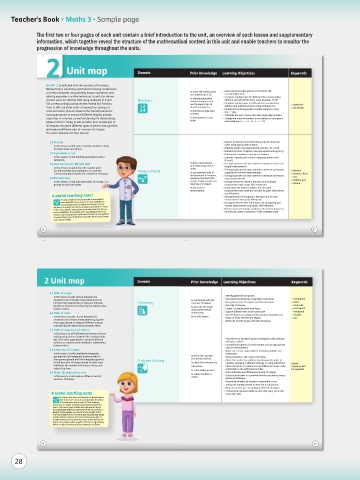
The first two or four pages of each unit contain a brief introduction to the unit, an overview of each lesson and supplementary
information, which together reveal the structure of the mathematical content in this unit and enable teachers to monitor the
progression of knowledge throughout the units.
2 Unit map Domain Prior Knowledge Learning Objectives Keywords
Learning Objectives
Keywords
Prior Knowledge
Domain
IN UNIT 2, Ss will deal with the domains of Numbers,
Measurement, Geometry and Problem Solving. Ss will solve > > Memorise all number pairs to 20 and write the
Memorise all number pairs to 20 and write the
Ss know the number pairs
a variety of puzzles using already known operations and Ss know the number pairs corresponding facts.
corresponding facts.
for numbers up to 20.
for numbers up to 20.
identify equivalent number sentences. Ss will also derive > > Complete number pairs for 1000 and the corresponding
Complete number pairs for 1000 and the corresponding
Ss identify equivalent
addition and subtraction facts, using multiples of 100.
Numbers
number pairs for 100 and 1000 using multiples of 5 and Numbers Ss identify equivalent addition and subtraction facts, using multiples of 100.
number sentences and
number sentences and
Complete number pairs for 100 and the corresponding
100 correspondingly and write the related fact families. use the equals sign to > > Complete number pairs for 100 and the corresponding > > equivalent
use the equals sign to
equivalent
addition and subtraction facts, using multiples of 5.
addition and subtraction facts, using multiples of 5.
Then Ss will calculate totals of money from groups of denote equivalence. > > Identify and write equivalent number sentences using > > calculation
denote equivalence.
calculation
Identify and write equivalent number sentences using
coins and notes, choose between the standard units the Ss add three single-digit the
Ss add three single-digit
the ‘ = ’ sign.‘ = ’ sign.
numbers.
most appropriate to measure different lengths, masses, numbers. > > Calculate the sum of more than two single-digit numbers.
Calculate the sum of more than two single-digit numbers.
Ss add numbers in any
capacities or volumes, as well as identify the relationships Ss add numbers in any > > Change the order of numbers in an addition to calculate a
Change the order of numbers in an addition to calculate a
order.
sum easily (e.g. 4 + 7 + 6 = 4 + 6 + 7 = 17).
between them. Finally, Ss will broaden their knowledge of order. sum easily (e.g. 4 + 7 + 6 = 4 + 6 + 7 = 17).
3D shapes, recognise different types of prisms and pyramids
and explore different nets of common 3D shapes.
The unit is divided into nine lessons:
Express an amount of money from groups of coins and
2.1 Puzzles > > Express an amount of money from groups of coins and
notes using appropriate notation.
In this lesson, Ss will solve a variety of puzzles using notes using appropriate notation.
Estimate length using appropriate units (m, cm, or km).
already known operations. > > Estimate length using appropriate units (m, cm, or km).
> > Estimate the mass of objects using appropriate units (kg or g).
Estimate the mass of objects using appropriate units (kg or g).
2.2 Equivalent or not > > Differentiate between capacity and volume.
Differentiate between capacity and volume.
In this lesson, Ss will identify equivalent number > > Estimate capacity and volume using appropriate units
In this lesson, Ss will identify equivalent number
Estimate capacity and volume using appropriate units
sentences. (l (l or ml). ).
or
ml
Ss find a total amount
Use appropriate tools and notation to measure and record
2.3 Fact families for 100 and 1000 Ss find a total amount > > Use appropriate tools and notation to measure and record
of money using coins or
of money using coins or
length measurements.
In this lesson, Ss will derive the number pairs notes. length measurements.
notes.
Use appropriate tools and notation to measure and record
Measurement
Measurement
for 100 and 1000 using multiples of 5 and 100 Measurement > > Use appropriate tools and notation to measure and record > > distance
distance
capacity and volume measurements.
Ss use standard units of
correspondingly and write the related fact families. Ss use standard units of capacity and volume measurements. > > kilometre (km)
kilometre (km)
correspondingly and write the related fact families.
measurement to estimate, > > Use appropriate tools and notation to measure and record
Use appropriate tools and notation to measure and record
measurement to estimate,
mass
measure and record the
2.4 Money totals measure and record the mass measurements. > > > mass ml )
mass measurements.
millilitre (
> millilitre (ml)
length, height, weight and
In this lesson, Ss will calculate totals of money from
Recognise that the metre is the basic unit of length
In this lesson, Ss will calculate totals of money from length, height, weight and > > Recognise that the metre is the basic unit of length
volume
capacity of an object.
groups of coins and notes. capacity of an object. measurement and equals 100 centimetres. > > volume
measurement and equals 100 centimetres.
Ss use tools of > > Understand the need for larger units of length
Ss use tools of
Understand the need for larger units of length
measurement. measurement and name the unit that includes 1000 metres
measurement.
measurement and name the unit that includes 1000 metres
as a kilometre.
as a kilometre.
A useful teaching note! > > Recognise that the kilogram is the basic unit of mass
Recognise that the kilogram is the basic unit of mass
Be aware that US coins and notes are presented measurement and equals 1000 grams.
measurement and equals 1000 grams.
as an example of currency. You may readjust the > > Recognise that the litre is the basic unit of capacity and
Recognise that the litre is the basic unit of capacity and
lesson plans based on the local currency of your
volume measurement and equals 1000 millilitres.
country. It is important that Ss recognise and learn the value volume measurement and equals 1000 millilitres.
Read a measurement by rounding to the nearest division or
of the coins and the notes they use in their everyday life, as > > Read a measurement by rounding to the nearest division or
half division given a complete or half-complete scale.
well as familiarise themselves with calculating amounts of half division given a complete or half-complete scale.
money. You may provide Ss with the RS Coins and notes from
Teacher's Resource CD ROM in case there aren't sets of coins
and notes available.
36 37
Maths3_TB_U2 Map.indd 36 1 /9/2020 11:10:01 πµ Maths3_TB_U2 Map.indd 37 1 /9/2020 11:10:02 πµ
2 Unit map Domain Prior Knowledge Learning Objectives Keywords
Domain
Learning Objectives
Prior Knowledge
Keywords
2.5 Units of length
> Identify pyramids and prisms.
> Identify pyramids and prisms.
In this lesson, Ss will choose between the
> rectangular
> Recognise the attributes of pyramids and prisms.
standard units of length measurement (cm, m, Ss are familiar with the > Recognise the attributes of pyramids and prisms. > rectangular
Ss are familiar with the
> prism
Geometry
> Recognise known 3D shapes and their attributes.
km) the most appropriate to measure different Geometry common 3D shapes. > Recognise known 3D shapes and their attributes. > prism
common 3D shapes.
> Describe 3D shapes.
> triangular
lengths or distances and identify the relationships Ss describe 3D shapes > Describe 3D shapes. > triangular
Ss describe 3D shapes
> Create 3D shapes given their faces.
between them. using mathematical > Create 3D shapes given their faces. > pentagonal
> pentagonal
using mathematical
> Explore different nets of the same cube.
> hexagonal
terminology.
2.6 Units of mass terminology. > Explore different nets of the same cube. > hexagonal
> circular
> Sort 3D shapes according to their attributes (number and
> circular
> Sort 3D shapes according to their attributes (number and
Ss sort 3D shapes.
In this lesson, Ss will choose between the Ss sort 3D shapes. shape of faces, vertices and edges). > net
> net
shape of faces, vertices and edges).
standard units of mass measurement (g, kg) the > Match 2D and 3D shapes with their drawings.
> Match 2D and 3D shapes with their drawings.
most appropriate to measure different masses
and identify the relationships between them.
2.7 Units of capacity and volume
In this lesson, Ss will differentiate between volume
and capacity, choose between the standard units
> Choose from a variety of known strategies to add, subtract,
(ml, l) the most appropriate to measure different > Choose from a variety of known strategies to add, subtract,
multiply or divide.
volumes or capacities and identify the relationships multiply or divide.
> Comprehend systems of measurement and use appropriate
between them. > Comprehend systems of measurement and use appropriate
units of measurement.
units of measurement.
2.8 Some new 3D shapes > Solve one- or two-step problems involving addition and
> Solve one- or two-step problems involving addition and
In this lesson, Ss will identify the triangular, subtraction.
subtraction.
Ss solve one- and two-
pentagonal and hexagonal prisms as well as Ss solve one- and two- > Solve problems in the context of money.
> Solve problems in the context of money.
step word problems.
the square pyramid and the triangular pyramid. Problem Solving step word problems. > Check the result of an addition by changing the order of
> Check the result of an addition by changing the order of
Problem Solving
Ss will describe 3D shapes based on their basic Ss check the outcome of a numbers, applying a different strategy, or using subtraction. Known
Ss check the outcome of a
numbers, applying a different strategy, or using subtraction.
Known
attributes; the number and shape of faces and calculation. > Check the result of a subtraction by adding the result of the keywords will
calculation.
keywords will
> Check the result of a subtraction by adding the result of the
edges they have. subtraction to the subtracted number. be repeated.
subtraction to the subtracted number.
be repeated.
Ss solve simple puzzles.
Ss solve simple puzzles.
> Find similarities and differences among 3D shapes.
2.9 Make 3D shapes from nets > Find similarities and differences among 3D shapes.
Ss relate numbers or
Ss relate numbers or
> Estimate an answer to a problem before calculating using a
In this lesson, Ss will explore different nets of shapes. > Estimate an answer to a problem before calculating using a
shapes.
variety of strategies.
common 3D shapes. variety of strategies.
> Determine whether an answer is reasonable or not.
> Determine whether an answer is reasonable or not.
> Justify the strategy chosen to work out a calculation.
> Justify the strategy chosen to work out a calculation.
> Work on number puzzles applying different strategies.
> Work on number puzzles applying different strategies.
> Find out how numbers relate to each other (e.g. 250 is 100
A useful teaching note! > Find out how numbers relate to each other (e.g. 250 is 100
more than 150.).
more than 150.).
Be aware that mass and weight are proportional
when we don’t take into consideration the e ect
of acceleration due to gravity. That explains
why the term weight is widely used instead of the term
mass. At a former age, Ss were not supposed to know
the substantial di erence between the terms mass and
weight. Subsequently, we used the term weight in the
corresponding lessons. Ss at this age will gradually begin
to di erentiate between the terms mass and weight. It
is important for you to know that mass is the amount of
matter in an object while weight is the force of gravity by
which an object is being attracted towards the Earth.
38 39
Maths3_TB_U2 Map.indd 38 1 /9/2020 11:11:03 πµ Maths3_TB_U2 Map.indd 39 1 /9/2020 11:11:03 πµ
28
Leaflet_Maths_2018.indd 28 17/9/2020 10: 9: 7 πµ

