


Page 23 - IPMaths_leaflet
P. 23
Sample page • Maths 1 • Teacher's Book


 2.6 Let’s put them together!                                                      2.6
 Learning Objectives                                   balls of play dough together and count aloud
 • Perceive addition as the act of combining numbers   2.6 Let’s put them together!   2.6  to find how many balls there are altogether.
 to find the total.   How many apples are there  altogether ?   Activities  • Have Ss repeat the activity until Ss have used
              1. Circle the correct number.
 •  se the addition and equals signs (+, =) to denote   a.  all their cards.
 addition in number sentences.
                       4                 +           2           =   7  /  5  /  6  • Give Ss some time to do the activity.
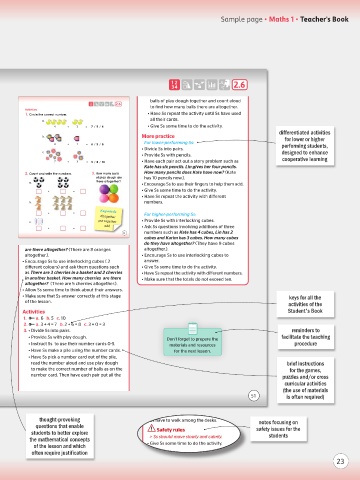
 Keywords                                                                                         differentiated activities
                   b.                               More practice                                  for lower or higher
 For the presentation of the keywords, see the       For lower-performing Ss:
 guidelines in the TB map.  4                 +           1            =  6  /  5  /  8  • Divide Ss into pairs.  performing students,
 > altogether    > put together     > add  c.       • Provide Ss with pencils.                    designed to enhance
                       7                 +           3            =   • Have each pair act out a story problem such as   cooperative learning
                       7                 +           3            =  9  /  8  /  10
 Materials and Resources                             Kate has six pencils. Lin gives her four pencils.
 •  umber cards  2. Count and write the numbers.  3.  How many balls   How many pencils does Kate have now? (Kate
                                     of play dough are
 • interlocking cubes (2 different colours), play dough,   Look!  a.  there altogether?  has 10 pencils now.).
 pencils                                            • Encourage Ss to use their fingers to help them add.
 When we put together, we add.  +  =                • Give Ss some time to do the activity.  1.2
 Common Student Preconceptions                      • Have Ss repeat the activity with different
 • Some Ss are familiar with various real life situations   b.  numbers.
 where they have to put things together (e.g. while   6  +  3  =  9  1.2  everyone has had the chance to give directions.
 playing or collecting items).   Activities  +  =  Keywords  For higher-performing Ss:
                                                        • Have Ss repeat the activity by changing the
                                      altogether
 • Some Ss may use the word add incorrectly, without    6 and 3 is 9.  c. 1. Tick (3) the correct word.  put together  • Provide Ss with interlocking cubes.
                                                         destinations on the city map.
                                      put together
 any mathematical meaning.  or example, I add   a.  She wants to take   =  b.  He wants to take the   • Ask Ss questions involving additions of three
                                                        • Give Ss some time to do the activity.
                                        add
                     +
 some sugar in my tea.   32  the ball. She walks:  fruits. He walks:    33  numbers such as Kate has 4 cubes, Lin has 2
                                                           Bookshop:  Go forwards, then turn left and

 • Some Ss may not use the symbols (+, =) correctly.   cubes and Karim has 3 cubes. How many cubes
                                                                   go forwards again.
 • Some Ss may not identify that the number that     do they have altogether? (They have 9 cubes

                                                           Lake:
 shows the total is equal to the number of the last   Look!  are there altogether? (There are 8 oranges   altogether.).  Go forwards, then turn right and
                                                                   go forwards again.
 ob ect to be counted.   • Draw Ss’ attention to the  ook  section.  altogether.).  forwards   • Encourage Ss to use interlocking cubes to
                  forwards

 • Some Ss may have di iculties with additions   • Have Ss count the red apples and then the green   • Encourage Ss to use interlocking cubes ( 2   answer.  Café:  Go backwards.
                  backwards
                                 backwards
                                                                   Go forwards.
                                                           School:

 involving  ero.  apples to conclude that there are 6 red apples   different colours) and ask them questions such      • Give Ss some time to do the activity.
               2. How can the girl go to the supermarket? Draw lines to match.

                                                           Museum:  Go forwards, turn right, go
 and 3 green apples.  as There are 3 cherries in a basket and 2 cherries   • Have Ss repeat the activity with different numbers.
 Cross Curriculum Links (CCL)  • Make sure that Ss do not miscount (e.g. Some Ss   in another basket. How many cherries  are there   • Make sure that the totals do not exceed ten.
                                                                   forwards, turn left, go forwards
                              Turn left.
 • This lesson can be linked with lesson 1.5 from  nit 1,   may count some ob ects more than once or not   altogether?  (There are 5 cherries altogether.).  again.
                          A
                                    B
 as Ss already know how to count up to ten ob ects.   count some ob ects at all.).  • Allow Ss some time to think about their answers.
                             Turn right.
 • Explain to Ss that they have to find how many red   • Make sure that Ss answer correctly at this stage   More practice  keys for all the
 and green apples there are altogether.  of the lesson.  For lower-performing Ss:                    activities of the
               3. Use the city map and give directions!
 • Explain to Ss that we count all the apples   Activities  Keywords  • Provide Ss with a pencil and a rubber.  Student's Book
                  City map
 together to find how many there are altogether.  directions  • Have Ss stand between desks so that they have
 LESSON PLAN  • Have Ss count aloud with you.  1.    a. 6   b. 5   c. 10   forwards  desks in front of and behind them.
 How many apples are there altogether?   • Make sure that Ss realise that they should start   2.    a. 3 + 4 = 7   b. 2 + 6 = 8   c. 3 + 0 = 3 backwards  Safety rules  reminders to
                                        turn left
             3. • Divide Ss into pairs.
 • Draw Ss’ attention to the picture and ask them to   counting the apples one by one and that the last   • Provide Ss with play dough.  turn right  > Ss should move slowly and calmly.  facilitate the teaching
 say what they can see (a man in a market, red and   number they say shows how many apples there   7  Don’t forget to prepare the   procedure
                                                             materials and resources
 green apples, oranges).  are altogether.  • Instruct Ss  to use their number cards 0-5.   • Explain to Ss that they have to put the pencil on
                                                               for the next lesson.
 • Ask Ss the introductory question How many   • Point out to Ss that there are 9 apples altogether.   • Have Ss make a pile using the number cards.  a desk in front of them and the rubber on a desk
               • Have Ss pick a number card out of the pile,
 apples are there altogether?  • Explain to Ss that when we put together, we add.  • Draw Ss’ attention to the picture in the previous   behind them.
               read the number aloud and use play dough
 • Allow Ss some time to think about their answers.  •  rite  6 + 3 = 9’ on the board.  section and ask them They want to go to the   • Explain to Ss that they should not turn to put down   brief instructions
               to make the correct number of balls as on the
 • Encourage Ss to express their opinions and   • Explain to Ss that we read (+) as  and’ and (=) as   forest. What directions will you give? (Go forwards   the rubber, but they have to take steps back.  for the games,
               number card. Then have each pair put all the
 initiate a short discussion in class.    is’, so we say that 6 and 3 is 9.  and turn right.), They want to go to the beach.   • Give Ss some time to do the activity.  puzzles and/or cross
 • Don’t correct Ss’ answers at this stage of the   • Draw Ss’ attention to the picture in the previous   What directions will you give? (Go backwards.).  curricular activities
 lesson.  section and ask them How many oranges   • Allow Ss some time to think about their answers.  For higher-performing Ss:  (the use of materials
 50            • Make sure that Ss answer correctly at this stage   • Have Ss stand up.   51        is often required)
               of the lesson.                         • Give Ss some directions to follow such as Go
                                                       forwards and turn right. Then walk backwards
               Activities                              and turn left.
                   a. forwards
               1.  thought-provoking                  • Ss have to walk among the desks.
                   questions that enable                                                   notes focusing on
                   b. backwards
               2. students to better explore             Safety rules                     safety issues for the
                   A. turn right
                    B. turn left                       > Ss should move slowly and calmly.    students
               the mathematical concepts
               3. • Divide Ss into pairs.             • Give Ss some time to do the activity.
                of the lesson and which
                 • Have one S in each pair think of a destination
                often require justification
                  on the city map, and give the appropriate
                                                                                                                     23
                  directions to the other S, so as to find this                                                      23
                  destination.
                 • Explain to Ss that they have to start from the
                  point where the boy is.                     Don’t forget to prepare the
                 • Make sure Ss in each pair swap roles so that
       Leaflet_Maths_2018.indd   23                            materials and resources                        17/9/2020   10: 9:19 πµ
                                                                 for the next lesson.
                                                                                          23

