


Page 22 - IPMaths_leaflet
P. 22
Teacher's Book • Maths 1 • Sample page
T e ac h er ' s B oo k • M a t h s 1 • S a mple p a g e
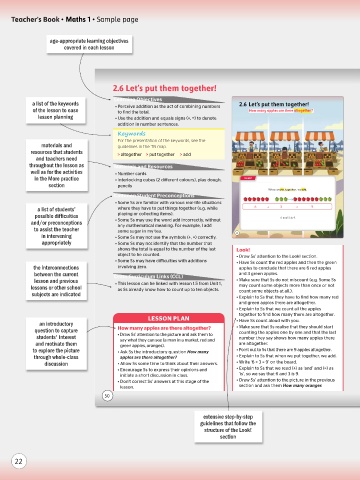
age-appropriate learning objectives
covered in each lesson
2.6 Let’s put them together! 2.6
Learning Objectives balls of play dough together and count aloud
a list of the keywords 2.6 Let’s put them together! 2.6
of the lesson to ease • Perceive addition as the act of combining numbers How many apples are there altogether ? Activities to find how many balls there are altogether.
to find the total.
lesson planning • se the addition and equals signs (+, =) to denote 1. Circle the correct number. • Have Ss repeat the activity until Ss have used
all their cards.
addition in number sentences. a.
4 + 2 = 7 / 5 / 6 • Give Ss some time to do the activity.
Keywords
b. More practice
For the presentation of the keywords, see the For lower-performing Ss:
materials and guidelines in the TB map. 4 + 1 = 6 / 5 / 8
resources that students > altogether > put together > add c. • Divide Ss into pairs.
and teachers need • Provide Ss with pencils.
• Have each pair act out a story problem such as
throughout the lesson as Materials and Resources 7 + 3 = 9 / 8 / 10 Kate has six pencils. Lin gives her four pencils.
well as for the activities • umber cards 2. Count and write the numbers. 3. How many balls How many pencils does Kate have now? (Kate
in the More practice • interlocking cubes (2 different colours), play dough, Look! of play dough are has 10 pencils now.).
there altogether?
section pencils a. • Encourage Ss to use their fingers to help them add.
When we put together, we add. + = • Give Ss some time to do the activity.
Common Student Preconceptions • Have Ss repeat the activity with different
• Some Ss are familiar with various real life situations b. numbers.
a list of students’ where they have to put things together (e.g. while 6 + 3 = 9 Keywords
possible difficulties playing or collecting items). 6 and 3 is 9. + = altogether For higher-performing Ss:
and/or preconceptions • Some Ss may use the word add incorrectly, without c. put together • Provide Ss with interlocking cubes.
to assist the teacher any mathematical meaning. or example, I add + = add • Ask Ss questions involving additions of three
some sugar in my tea.
in intervening • Some Ss may not use the symbols (+, =) correctly. 32 33 numbers such as Kate has 4 cubes, Lin has 2
cubes and Karim has 3 cubes. How many cubes
appropriately • Some Ss may not identify that the number that do they have altogether? (They have 9 cubes
shows the total is equal to the number of the last Look! are there altogether? (There are 8 oranges altogether.).
ob ect to be counted. • Draw Ss’ attention to the ook section. altogether.). • Encourage Ss to use interlocking cubes to
• Some Ss may have di iculties with additions • Have Ss count the red apples and then the green • Encourage Ss to use interlocking cubes ( 2 answer.
the interconnections involving ero. apples to conclude that there are 6 red apples different colours) and ask them questions such • Give Ss some time to do the activity.
between the current Cross Curriculum Links (CCL) and 3 green apples. as There are 3 cherries in a basket and 2 cherries • Have Ss repeat the activity with different numbers.
lesson and previous • This lesson can be linked with lesson 1.5 from nit 1, • Make sure that Ss do not miscount (e.g. Some Ss in another basket. How many cherries are there • Make sure that the totals do not exceed ten.
altogether? (There are 5 cherries altogether.).
lessons or other school as Ss already know how to count up to ten ob ects. may count some ob ects more than once or not • Allow Ss some time to think about their answers.
subjects are indicated count some ob ects at all.).
• Explain to Ss that they have to find how many red • Make sure that Ss answer correctly at this stage
and green apples there are altogether. of the lesson.
• Explain to Ss that we count all the apples Activities
together to find how many there are altogether.
LESSON PLAN 1. a. 6 b. 5 c. 10
an introductory • Have Ss count aloud with you. 2. a. 3 + 4 = 7 b. 2 + 6 = 8 c. 3 + 0 = 3
question to capture How many apples are there altogether? • Make sure that Ss realise that they should start 3. • Divide Ss into pairs.
counting the apples one by one and that the last
students' interest • Draw Ss’ attention to the picture and ask them to number they say shows how many apples there • Provide Ss with play dough. Don’t forget to prepare the
and motivate them say what they can see (a man in a market, red and are altogether. • Instruct Ss to use their number cards 0-5. materials and resources
green apples, oranges).
to explore the picture • Ask Ss the introductory question How many • Point out to Ss that there are 9 apples altogether. • Have Ss make a pile using the number cards. for the next lesson.
through whole-class apples are there altogether? • Explain to Ss that when we put together, we add. • Have Ss pick a number card out of the pile,
discussion • Allow Ss some time to think about their answers. • rite 6 + 3 = 9’ on the board. read the number aloud and use play dough
• Encourage Ss to express their opinions and • Explain to Ss that we read (+) as and’ and (=) as to make the correct number of balls as on the
initiate a short discussion in class. is’, so we say that 6 and 3 is 9. number card. Then have each pair put all the
• Don’t correct Ss’ answers at this stage of the • Draw Ss’ attention to the picture in the previous
lesson. section and ask them How many oranges
50 51
extensive step-by-step
guidelines that follow the
structure of the Look!
section
22
22
Leaflet_Maths_2018.indd 22 17/9/2020 10: 9:17 πµ

