Page 21 - IPMaths_leaflet
P. 21

Sample page • Maths 1 • Workbook

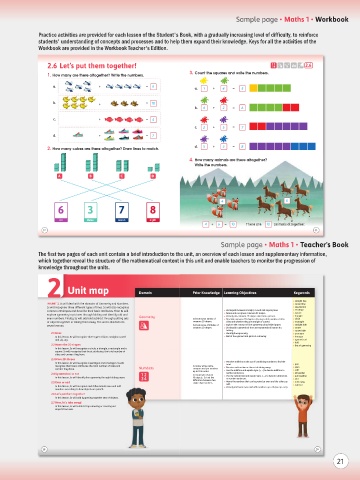
                  Practice activities are provided for each lesson of the Student's Book, with a gradually increasing level of difficulty, to reinforce
                  students' understanding of concepts and processes and to help them expand their knowledge. Keys for all the activities of the
                  Workbook are provided in the Workbook Teacher's Edition.

                     2.6 Let’s put them together!                                                         2.6

                     1. How many are there altogether? Write the numbers.   3. Count the squares and write the numbers.
                       a.             +               =  9            a.  1  +  4  =  5

                       b.             +               = 10
                                                                      b.  4  +  2  =  6

                       c.             +               =  4
                                                                      c.  2  +  5  =  7
                       d.             +               =  7
                                                                      d.  5  +  3  =  8
                     2. How many cubes are there altogether? Draw lines to match.
                                                                    4.  How many animals are there altogether?
                                                                      Write the numbers.
                        A          B         C         D


                                                                              4                     6
                        6         3          7         8

                         six      three     seven      eight
                                                                                             10
                                                                         4  +  6  =  10  There are              animals altogether.
                   32                                                                                        33
                                                                              Sample page • Maths 1 • Teacher's Book
                  The first two pages of each unit contain a brief introduction to the unit, an overview of each lesson and supplementary information,
                  which together reveal the structure of the mathematical content in this unit and enable teachers to monitor the progression of
                  knowledge throughout the units.
                     2      Unit map               DomainDomain      Prior KnowledgePrior Knowledge  Learning ObjectivesLearning Objectives  KeywordsKeywords


                                                                                                      >
                                                                                                      >  straight line straight line

                     IN UNIT 2, Ss will deal with the domains of Geometry and Numbers.                >  curved line curved line

                                                                                                      >
                     Ss will recognise three different types of lines. Ss will also recognise         > zig-zag line  zig-zag line
                                                                                                      >
                                                                                                      >

                     common 2D shapes and describe their basic attributes. Then Ss will   >  Distinguish between straight, curved and zig-zag lines.Distinguish between straight, curved and zig-zag lines.  > 2D shape 2D shape
                                                                               >

                                                                                                      >
                                                                               >


                     explore symmetry in pictures through folding and identify odd and   GeometryGeometry  >  Name and recognise common 2D shapes.Name and recognise common 2D shapes.  > square  square

                                                                                                      > triangle  triangle
                                                                               >  Identify the common 2D shapes that form a picture.Identify the common 2D shapes that form a picture.

                                                                               >
                                                                                                      >
                     even numbers. Finally, Ss will add and subtract through putting sets   Ss know some names of Ss know some names of   >  Describe common 2D shapes referring to the number of their Describe common 2D shapes referring to the number of their   > circle circle
                                                                               >
                                                                                                      >


                                                                                                      >
                     of objects together or taking them away. The unit is divided into   common 2D shapes. common 2D shapes.   sides and whether they are straight or curved.sides and whether they are straight or curved.  > rectanglerectangle

                                                                               >
                                                                                                      >

                     seven lessons:                                  Ss know some attributes of Ss know some attributes of   >  Explore the concept of line symmetry using folded paper.Explore the concept of line symmetry using folded paper.  > straight side straight side
                                                                     common 2D shapes. common 2D shapes.   >  Distinguish symmetrical from non-symmetrical images by Distinguish symmetrical from non-symmetrical images by   > corner corner
                                                                               >


                                                                                                      >
                                                                                folding.folding.      > curved side  curved side
                                                                                                      >
                      2.1 Lines                                                >  Identify line symmetry.Identify line symmetry.  > pentagon pentagon
                                                                                                      >


                                                                               >


                                                                                                      >
                                                                               >
                       In this lesson, Ss will recognise three types of lines: straight, curved   >  Match the symmetrical parts of a drawing.Match the symmetrical parts of a drawing.  > hexagon  hexagon
                                                                                                      >
                       and zig-zag.                                                                   > symmetricalsymmetrical
                                                                                                      >
                                                                                                      > foldfold
                      2.2 Name the 2D shapes                                                          > line of symmetry  line of symmetry
                                                                                                      >
                       In this lesson, Ss will recognise a circle, a triangle, a rectangle and a
                       square. Ss will recognise their basic attributes; the total number of
                       sides and corners they have.
                      2.3 More 2D shapes
                                                                               >  Perceive addition as the act of combining numbers to find the Perceive addition as the act of combining numbers to find the


                                                                               >
                       In this lesson, Ss will recognise a pentagon and a hexagon. Ss will   total.total.  > pair  pair
                                                                                                      >
                       recognise their basic attributes; the total number of sides and   Ss name, write, recite, Ss name, write, recite,   >  Perceive subtraction as the act of taking away.Perceive subtraction as the act of taking away.  > even  even


                                                                                                      >
                                                                               >
                       corners they have.          NumbersNumbers    compare and put numbers compare and put numbers   >  Use the addition and equals signs (+, =) to denote addition in Use the addition and equals signs (+, =) to denote addition in   > odd  odd
                                                                                                      >
                                                                               >


                                                                     up to 10 in order.up to 10 in order.
                                                                                                      >
                      2.4 Symmetrical or not                         Ss count sets of up to Ss count sets of up to   number sentences.number sentences.  > altogether altogether

                                                                               >
                                                                                                      >

                       In this lesson, Ss will identify line symmetry through folding paper.  10 objects.  Ss find the 10 objects.  Ss find the   >  Use the subtraction and equals signs (-, =) to denote subtraction Use the subtraction and equals signs (-, =) to denote subtraction   > put together  put together
                                                                                in number sentences.in number sentences.
                                                                                                      >
                                                                                                      > add  add
                      2.5 Even or odd                                difference between two difference between two   >  Name the numbers that can be paired as even and the others as Name the numbers that can be paired as even and the others as   > take away  take away
                                                                                                      >
                                                                               >


                                                                     single-digit numbers. single-digit numbers.
                                                                                odd.odd.
                                                                                                      >
                       In this lesson, Ss will recognise and differentiate even and odd   >  Identify and name even and odd numbers up to 10 (except zero).Identify and name even and odd numbers up to 10 (except zero).  > subtract subtract
                                                                               >


                       numbers according to how objects are paired.
                      2.6 Let’s put them together!
                       In this lesson, Ss will add by putting together sets of objects.
                      2.7 Now, let’s take away!
                       In this lesson, Ss will subtract by removing or crossing out
                       objects from sets.
                   38                                                                                         39
                                                                                                                     21
                  Maths1_TB_U2 Map.indd   38                16/9/2020   12:05:47 µµ  Maths1_TB_U2 Map.indd   39  16/9/2020   12:05:51 µµ
       Leaflet_Maths_2018.indd   21                                                                           17/9/2020   10: 9:1  πµ
   16   17   18   19   20   21   22   23   24   25   26